The human capacity for inventiveness knows no bounds – especially sometimes, when a life or death situation presents itself. Like, how to save thousands of refugees – with something as bizarre as a Nazi flag!
Let me tell you a story.
In the mid 1930’s the Japanese Army invaded China in a campaign of conquest, murder and destruction.
In the annals of history there was nothing quite as horrific as the ultimate Japanese all-out attack on the city of Nanjing in 1937.
From the air and the ground, a great slaughter loomed, and many Chinese citizens as they tried to flee, were killed in appalling ways.
Western diplomats and most foreign nationals had fled, but a few foreigners remained.
Fitfteen American and European missionaries and businessmen forming part of the remaining group, set out to protect as many Chinese as they could from the impending Japanese massacre.
They set up what became known as The Nanking Safety Zone which sheltered approximately 250,000 Chinese people from attack by the Japanese and to provide refugees with food and shelter.
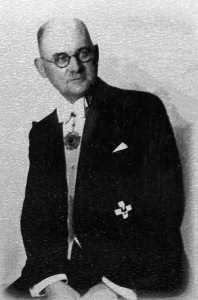
John Heinrich Detlef Rabe (1882–1950). DrSivle, Wikimedia Commons.
In charge was a man called John Rabe, a diplomat and businessman who had been sent to China as an official German representative in the European-U.S. diplomatic quarter in Nanjing
At the time of the Japanese attack on Nanjing, Rabe was a staunch Nazi and the party’s local head, serving as a Deputy Group Leader in the Nazi Party.
A member of the Nazi Party, Rabe had never been to Hitler’s Germany or seen firsthand what was going on there; even so, he didn’t believe the mounting criticisms he heard about Hitler.
Germany and Japan were allies, and in the film, when Japanese planes first bomb the city, Rabe and his workers unfurl a giant Nazi flag like a canopy over their heads, in hopes the Japanese pilots will spare them.
Historical photos showed Rabe using the Nazi flag to construct makeshift shelters for the more than 600 Chinese refugees who camped out at his house and in his garden after the Japanese army took over Nanjing.
John Rabe explained his reasons as: “There is a question of morality here… I cannot bring myself for now to betray the trust these people have put in me, and it is touching to see how they believe in me”.
However, like the term “Nazi,” the swastika did not yet designate evil for Rabe. Whereas it was abhorred in the rest of the world, the Nazi swastika possessed a life-saving force in Nanking.
He carried out his responsibilities as chair to the best of his abilities under exceedingly difficult conditions. He often rushed to save women from being raped or properties from being ransacked by waving his swastika armband under the nose of Japanese soldiers
Modern estimates of the death toll of the Nanjing Massacre vary, but some put the number of murdered civilians as high as 300,000.
Rabe and his zone administrators tried frantically to stop the atrocities. Rabe’s appeals to the Japanese using his Nazi Party credentials often only delayed them, but the delay allowed hundreds of thousands of refugees to escape.
Rabe is credited with saving the lives of as many as 300,000 Chinese civilians.
On 28 February 1938, Rabe left Nanjing, returning to Berlin. He took with him a large number of source materials documenting Japanese atrocities in Nanjing.
Rabe showed films and photographs of Japanese atrocities in lecture presentations in Germans, and he wrote to Hitler, asking him to use his influence to persuade the Japanese to stop further violence.
Rabe was detained and interrogated by the Gestapo; his letter was never delivered to Hitler. He was allowed to keep evidence of the massacre (excluding films) but not to lecture or write on the subject again.
After the war, Rabe was arrested first by the Soviet NKVD, then by the British Army. Both let him go after intense interrogation.
He worked sporadically for the Siemens company, earning little. He was later denounced by an acquaintance for his Nazi Party membership, losing the work permit he had been given by the British Zone of Occupation.
Unable to work and with his savings spent, Rabe and his family survived in a one-room apartment by selling his Chinese art collection but it was insufficient to prevent their malnutrition. He was formally declared “de-Nazified” by the British on 3 June 1946 but continued to live in poverty.
In 1948, Nanjing citizens learned of the Rabe family’s dire circumstances and quickly raised a sum of money equivalent to US$26,000 in 2025.
The city’s mayor travelled to Germany and he bought a large amount of food for the Rabe family. From mid-1948 until the Chinese Revolution, the people of Nanjing also sent the family a food package each month, for which Rabe wrote many letters expressing deep gratitude.
It was not until 2003 that his humanitarian work in Nanking was officially recognized by the then German President Johannes Rau with a visit to Rabe’s memorial in Nanking.
Subsequently, a John Rabe Communication Centre was established in Heidelberg .
His bravery would earn him the nicknames: “The Living Buddha of Nanjing”, “The Good Nazi” and “The Schindler of Nanking” by the Chinese.
I cannot help remembering a paraphrase of the verse which reminds us, ‘Greater love has no man than this, but that he lays down his lives for others.”